
Evaluating the Morphological Traits of Spherocytic Red Blood Cells and Their Relevance in Predicting Patient Prognosis within Hematological Disorders
- Dan Ngugi, Coast General Teaching and Referral Hospital
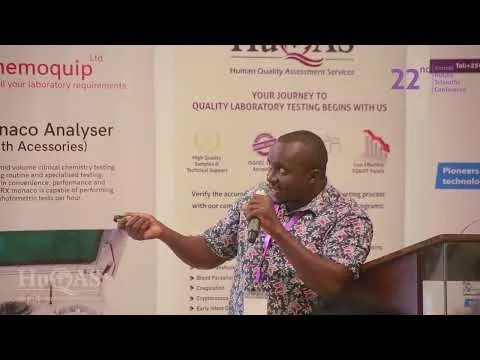
Presented at 22nd Annual HuQAS Scientific Conference
Introduction
Hematological disorders encompass a diverse array of conditions that affect the blood and its constituents. This study focuses on the examination of morphological features of abnormal red blood cells (RBCs) displaying spherocytosis. It places particular emphasis on evaluating the influence of anisocytosis, poikilocytosis, and the presence of inclusion bodies within RBCs. These specific characteristics are integral to the exploration of the fundamental pathophysiological mechanisms underlying hematological disorders and, significantly, in assessing their capacity to predict patient prognosis.
Study Objectives
To analyze anisocytosis, poikilocytosis, and inclusion bodies within spherocytic red blood cells (RBCs) in a cohort of 73 patients with hematological disordersand monitor them for a three-month duration to infer their prognosis To evaluate the correlation and regression analysis between the extent of aniso cytosis, poikilocytosis, and inclusion bodies in RBCs displaying spherocytosis morphology and the prognosis of patients within three months.
Methodology:
Study Design: This research utilized a prospective cohort study design to initially examine the morphological features of spherocytic red blood cells (RBCs) and subse quently track patient prognosis at the three-month mark. The primary objective was to determine the significance of these morphological features in predicting patientprognosis in the context of hematological disorders.
Participant Selection:
Study subjects were selected from a pool of individuals diagnosed with hematological disorders. A cohort of 73 patients was recruited, with careful consideration to include a diverse range of ages, sexes, and types of hematological disorders to ensure a comprehensive and representative sample.
Data Collection:
Morphological Evaluation: Initially, we conducted a microscopic analysis of peripheral blood smears at baseline to scrutinize anisocytosis, poikilocytosis, and the existence of inclusion bodies within spherocytic red blood cells.
Follow-up:
Over the course of three months, study participants were monitored, during which their prognosis was consistently observed. This comprehensive assessment included documentation of their overall prognosis and, when applicable, their status at the conclusion of the study, or in case of patient mortality.
Data Analysis:
Correlation analysis and regression: Spearman’s rank correlation coefficient and multinomial regression analysis were employed to evaluate the relationship between the extent of anisocytosis, poikilocytosis, and inclusion bodies in RBCs displaying spherocytosis morphology and patient prognosis.
Data Management:
All collected data were securely stored and anonymized to ensure participant confidentiality. Data analysis was performed using R 4.3.1 ensuring the accuracy and reliability of the findings.
Timeline:
The study was conducted from 15th may to 30th August to fulfill the specified objectives
Results
Objective one
To analyze anisocytosis, poikilocytosis, and inclusion bodies within spherocytic red blood cells (RBCs) in a cohort of 73 patients with hematological disorders and monitor them for a three-month duration to infer their prognosis
Objective two
To evaluate correlation and regression analysis between extent of anisocytosis, poikilocytosis, and inclusion bodies in RBCs displaying spherocytosis morphology and the prognosis of patients within three-month
Discussion
The analysis of the data using Spearman’s rank correlation in R 4.3.1 revealed several key findings: Anisocytosis and Prognosis: The Spearman’s rank correlation coefficient (Spearman’s rho) between Anisocytosis and Prognosis is approximately -0.9114. This strong negative correlation suggests a significant association between Anisocytosis and Prognosis. Specifically, patients with higher anisocytosis levels tend to have a poorer prognosis.
Poikilocytosis and Prognosis:
The Spearman’s rank correlation coefficient between Poikilocytosis and Prognosis was approximately -0.6588. This negative correlation indicates a meaningful relationship between Poikilocytosis and Prognosis. Patients with higher poikilocytosis levels are more likely to have a poorer prognosis.
Inclusion Bodies and Prognosis: The correlation coefficient (Spearman’s rho) between Inclusion Bodies and Prognosis was approximately -0.1228. Although this correlation is relatively weak, its negative direction suggests a slight tendency for patients with a higher presence of Inclusion Bodies in their red blood cells to have a slightly poorer prognosis. However, it is important to note that this relationship is not as strong as that observed with Anisocytosis and Poikilocytosis. The same raw data were further analyzed using multinomial regression analysis to validate previous findings regarding correlations. The results of the regression analysis align with the correlation findings, providing further support for the associations observed. Anisocytosis: Higher levels of anisocytosis are associated with a higher likelihood of fair prognosis and a lower likelihood of poor prognosis.
Poikilocytosis: Higher levels of poikilocytosis are associated with a higher likelihood of poor prognosis and a lower likelihood of fair prognosis. Inclusion_Bodies: Higher levels of Inclusion_Bodies are associated with a higher likelihood of fair prognosis and a lower likelihood of poor prognosis. In this study most of the p-values are extremely small (close to zero), which is reflected in the “Inf” values for -log10(Value). This means that for many coefficients, there is very strong evidence against the null hypothesis, indicating that these coefficients are statistically significant in explaining the variation in your data. The p-values that are not “Inf” (e.g., 6.385998) are still very small and indicate statistical significance.
However, they are not as extreme as the “Inf” values. P-Values suggest that the coefficients in this study are highly statistically significant, indicating that the variables (Anisocytosis, Poikilocytosis, Inclusion_Bodies) are important in explaining the variation in your data related to Prognosis. These results provide strong evidence that these variables have a significant impact on the Patient outcome
Significance of the Study
These findings hold significant importance for healthcare professionals, as they offer valuable insights into potential indicators of patient prognosis. Practitioners can use this information to identify patients at a higher risk of adverse outcomes. For instance, patients with low anisocytosis, low poikilocytosis, and low Inclusion_Bodies are more likely to have an excellent prognosis. In contrast, those with moderate or high levels of these factors may face an increased risk of Fair or Poor prognosis. However, it is crucial to emphasize that these indicators should be considered along side clinical judgment and additional medical data when making decisions regarding patient care and treatment strategies. Healthcare providers should adopt a holistic approach to patient assessment, taking into account various factors to ensure the most informed and personalized care possible
Recommendation
Suggest study expands its scope by increasing the sample size and extending the duration of data collection. This will enable to gather a more substantial amount of data over a longer period, providing a more comprehensive and detailed understanding of how parameters related to Spherocytic Red Blood Cells (RBCs) are interconnected with patient prognosis.