
Perfomance Results For Medical Laboratories Participants In HuQAS Malaria Microscopy EQA Program Between The Year 2020 and 2022
- Michael Watene, Human Quality Assessment Services
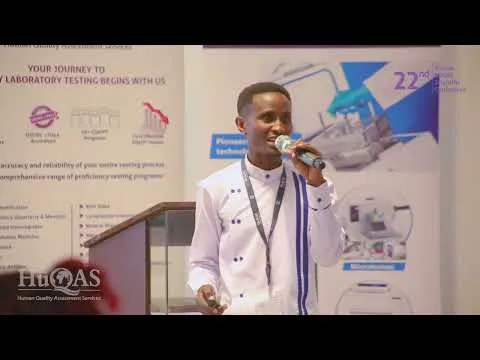
Presented at 22nd Annual HuQAS Scientific Conference
Introduction
Malaria microscopy is a skill that is very key in diagnosing malaria by detecting, identifying differents species of plasmodium and the level parasitemia by examining a stained blood film. Quality results depend on the microscopy skills of the personnel, quality of the reagents and the status of the microscope. Quality control aspect must be taken in to account for production of quality results. Quality control entails trained personnel, properly working standard operating procedures, validation of giemsa stains, inclusion of internal control and participating in proficiency testing. The sure way to ensure quality of results is by continuously monitoring the performance of the labaratory through q quality external quality assurance program.
Methods
The performance evaluation is based on assessment of retrospective data for laboratories that participated in the HuQAS EQA malaria microscopy program batween the 1st event 2020 to 3rd event 2022. The program was offered three times in a year. Enrolled participants were trained on the HuQAS informatics,an online platform to submit and view their reports. During the test events, the facilities were supplied with Giemsa Stained blood films to detect malaria parasites, identify the species of plasmodium, identify the species stage and quantify where applicable. As facilities participated in EQA, they also identified and mitigated gaps to better improve their performance like on-site microscopy support, CMEs, and Microcopy refresher trainings.
Results
The three years of the study had 9 test events where 1959 Giemsa-stained slides were supplied to the participants who examined and submitted their reports through the HuQAS informatics. After analysis the average performance at detection, species identification and quantification was at 90%, 68% and 18% respectively.
Conclusion
The participants met the acceptable score of 90% in detection of malaria parasites. However, there is need for improvement to be able to produce accurate results for malaria microscopy to attain a 90% score in speciation and minimum score of 50% in quantification as per WHO requirements. External Quality assessment can be strengthened through on-site support supervisions, slide rechecking, continuous medical educations and malaria microscopy refresher trainings to instil skills and competency to the malaria microscopists. These support programs can only be done by a skilled malaria microscopist preferably a level one or level two.